
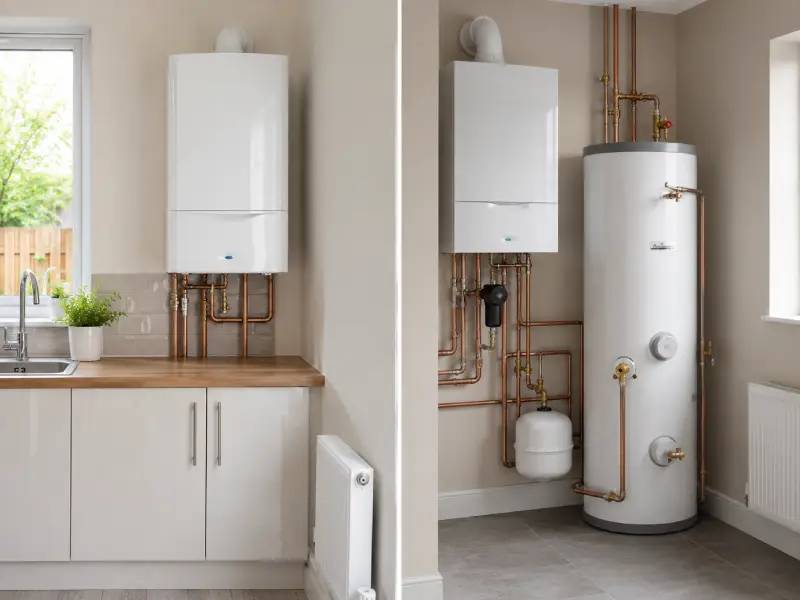
Choosing the right boiler system has a direct effect on everyday comfort, heating performance, energy bills, installation cost, available space and long-term maintenance. For homeowners in South London, the best option can vary widely because properties range from compact flats and maisonettes to terraced houses and larger family homes.
The two most common choices are a combi boiler system and a boiler system with a separate hot water cylinder. Both can provide central heating and hot water, but they work in different ways. This guide compares how each system operates, the key technical differences, their pros and cons, and which households they usually suit best.
What Is a Combi Boiler?
A combination boiler, commonly called a combi boiler, is a compact, high-efficiency unit that delivers both central heating and instant hot water from a single appliance. Unlike traditional setups, a combi boiler does not need a separate hot water cylinder or cold water storage tank.
Here’s how it works: cold mains water flows directly into the boiler. When you turn on a hot tap or shower, the boiler heats the water on demand and sends it straight to the outlet. This provides hot water only when you need it, making it a convenient and space-saving solution.
Key technical points:
Hot water is heated instantaneously rather than stored. Water pressure relies heavily on incoming mains pressure. Typical domestic combi boiler outputs range from 24–40 kW for hot water and 18–30 kW for central heating, depending on property size. Flow rate is a critical parameter: smaller models deliver around 9–12 litres per minute, while larger ones can reach 14–18 litres per minute. Best performance is usually achieved when using only one hot water outlet at a time.
What Is a Boiler with a Hot Water Cylinder?
This setup uses a boiler paired with a separate hot water cylinder to store preheated water for later use. It typically refers to either a system boiler with an unvented hot water cylinder or a regular/conventional boiler with a vented cylinder and cold water tank in the loft.
The boiler heats water that is stored in the cylinder, ready for immediate draw-off. This means hot water is available from the stored supply rather than being heated only at the point of use. These systems are common in larger homes, properties with multiple bathrooms, and households where several people may need hot water simultaneously.
Key technical points:
Hot water is stored in a cylinder, with capacity usually measured in litres. Common domestic sizes include 120–150 litres for smaller homes, 180–210 litres for medium homes, and 250–300+ litres for larger households. These systems handle multiple simultaneous outlets more effectively. They may require airing cupboard space for the cylinder, loft space for a cold water tank (in vented systems), or an expansion vessel and safety controls for unvented cylinders. An unvented cylinder can deliver strong hot water pressure when mains pressure is adequate.
Main Difference: Instant Hot Water vs Stored Hot Water
The core distinction is simple yet important. A combi boiler heats water instantly as you need it, while a cylinder system stores hot water for on-demand use.
With a combi boiler, you get hot water on demand without waiting for a tank to recover, but supply can be limited if demand is high. A cylinder system provides a ready reserve that can serve several outlets at once, though the cylinder may eventually run out during very heavy use and require time to reheat.
Space Requirements
Combi boiler
These are compact, all-in-one units that are usually wall-mounted in the kitchen, utility room, or a cupboard. No separate cylinder is needed, making them ideal for small South London flats and properties where storage space is limited.
Boiler with cylinder
This requires additional space for the boiler, hot water cylinder, and possibly a cold water tank. Installation often occurs in an airing cupboard, loft, or utility room. It suits homes with available space and higher hot water demand.
Hot Water Performance and Flow Rate
Combi boiler
Performance depends on boiler size and incoming mains pressure. It works best for one shower or outlet at a time. Important parameters include hot water output in kW, flow rate in litres per minute, incoming mains water pressure, and temperature rise (often around 35°C).
Boiler with hot water cylinder
These systems deliver higher hot water volume and cope better with multiple bathrooms and larger families. Key factors are cylinder capacity in litres, recovery time, heat loss rating, mains pressure (for unvented models), and the number of bathrooms and occupants.
Heating Performance
Both systems can effectively heat radiators or underfloor heating. Central heating performance depends on boiler output, the number of radiators, property size, insulation levels, and accurate heat loss calculations. Professional assessment is recommended rather than sizing based solely on floor area. Oversizing a boiler can reduce efficiency and increase wear and tear.
Energy Efficiency
Combi boiler
These are efficient because water is only heated when needed, with no standing heat loss from a stored cylinder. They can be very cost-effective for smaller households, though gas usage may rise during periods of high hot water demand.
Boiler with cylinder
Modern cylinders are well insulated, but some heat loss still occurs. They perform efficiently with predictable demand patterns and work well with smart controls and timed schedules. Many are compatible with solar thermal or other renewables.
Installation Cost and Complexity
Combi boiler
Installation is often simpler, especially when replacing an existing combi. Material costs are lower without a separate cylinder. Upgrades may still be needed for gas pipework, condensate pipe, flue position, system filters, and controls.
Boiler with cylinder
This involves more complex installation and higher upfront costs due to the cylinder, additional pipework, valves, controls, and possible expansion vessels or system conversions. Unvented cylinders should always be fitted by qualified professionals.
Running Costs
Running costs depend more on household habits than boiler type alone. A combi boiler may prove cheaper for one or two occupants with lower hot water demand. Cylinder systems can be more practical for families with two or more bathrooms and frequent simultaneous use. Key factors include gas usage, hot water demand, boiler efficiency, cylinder insulation, thermostat settings, smart controls, and regular boiler service.
Water Pressure and Shower Performance
Combi boiler
Hot water pressure depends entirely on mains supply. Good mains pressure is essential, but the system may not support several powerful showers simultaneously.
Boiler with cylinder
Unvented cylinders can provide strong shower performance and support multiple bathrooms effectively. Vented systems may need pumps for adequate pressure. Important checks include mains flow rate, static and dynamic pressure, pipe size, and number of outlets.
Reliability and Maintenance
Combi boiler
Fewer external components, but internal parts handle both heating and hot water. A breakdown usually affects both services at once.
Boiler with cylinder
More components overall, but greater flexibility. Many include an immersion heater as backup. Regular checks are needed on motorised valves, expansion vessels, pressure relief valves, cylinder thermostats, immersion heaters, pumps, and controls. A professional boiler service helps maintain reliability for both types.
Pros and Cons of a Combi Boiler
Pros:
- Space-saving: Perfect for South London’s smaller properties.
- Efficiency: Heats water only when you need it.
- Installation: Usually faster and more affordable.
- Freshness: Water is delivered straight from the mains, not stored.
Cons:
- Flow rate: Limited by the boiler’s size.
- Simultaneous use: Struggling to provide water to two taps at once.
- Reliability: No backup hot water if the unit fails.
Pros and Cons of a Boiler with Hot Water Cylinder
Pros:
- Volume: Can supply multiple bathrooms simultaneously.
- Pressure: Unvented cylinders offer fantastic shower performance.
- Backup: Immersion heaters provide an emergency hot water source.
- Future-proof: Easier to integrate with solar or heat pumps.
Cons:
- Space: Requires a dedicated cupboard and potentially loft space.
- Heat loss: Some energy is lost from the stored water.
- Waiting time: Once the tank is empty, it takes time to reheat.
Which System Is Best for Different Types of Homes?
A combi boiler is usually best for flats, small terraced houses, one-bathroom homes, one to three occupants, properties with limited cupboard or loft space and homes with moderate hot water demand.
A boiler with a hot water cylinder is usually better for larger houses, homes with two or more bathrooms, families with high hot water usage, properties where several showers or taps may be used at once, homes with space for a cylinder and households planning solar thermal or future renewable integration.
Get Expert Advice for Your South London Home
Deciding between a combi boiler system and a traditional setup with a cylinder can feel overwhelming, but the right choice will improve comfort and efficiency for years to come.
Green London Plumbers can advise homeowners across South London on boiler repairs, suitable plumbing solutions, system upgrades and professional boiler services options tailored to the needs of each home.
Contact Green London Plumbers today for a consultation and take the first step toward a more efficient home.